← David Randolph CASE 01 / 04
Motion graphic · 24-second loop · illustrative, sample data

FIELD WORK EXECUTION · ELECTRIC UTILITY · MOBILE + WEB

On My Way: from work request to closed job, in one app

On My Way (OMW) is National Grid's mobile and web work execution app for the US electric business. It gives field crews and supervisors real-time work information to manage, complete and close out jobs. I led strategy and product design for the rebuild and replatform of its service-job apps and three new feature areas. The project received a Chairman's Award.

MY ROLE
Lead strategy & product design · business & data analyst · interim PM (3 months)
TEAM
2 designers, 1 researcher, 2 PMs, 16 engineers, 2 business strategists, 2 business owners, 2 change managers
TIMELINE
Nov 2023 – Jun 2024 · National Grid
METHODS
Field studies, SME and user interviews, 8 moderated usability sessions, mid-sprint reviews
45→83%
Share of jobs completed, before vs. after the rebuild
< 6 hrs
To get work requests digitally to field crews (MA and NY)
2 fewer
Paper hand-offs between supervisor, clerks and work order completion
Award
Chairman's Award for the project
01 — THE PROBLEM

Every hand-off was a place work could stall

A single electric service job passes through many hands: the request is issued, a crew takes it, time gets logged, paperwork goes to a supervisor for approval, and the approved paperwork moves to the team that closes the work order. Each hand-off was a chance for a delay, a drive back to the barn or another phone call.

I framed each pain point against what OMW would change, so every feature we scoped answered a real problem in the field.

Problem framing: what crews and supervisors struggled with, and how OMW answers each. Recreated from the OMW strategy overview.
02 — SCOPE

Drawing the line at short-cycle work

OMW didn't try to digitize everything at once. We scoped it to Overhead Service and Streetlight work requests under six man-hours in Massachusetts and New York: high-volume jobs where paper cost crews the most time. Larger projects, underground and substation work stayed out until the core loop was proven.

The scope line: what OMW supports and what it deliberately leaves out.
03 — THE USERS

Crews in the field, and everyone their work touches

Crews and supervisors use OMW every day, but its data flows on to barn clerks, work order completion and maps & records. Mapping who touched the work, and what the business expected to gain, kept design decisions tied to the business case.

Users, downstream stakeholders and the business case benefit levers OMW was measured against.
04 — MY ROLE

Design lead, analyst and, for three months, PM

I led product strategy and design, worked as the business and data analyst connecting the app to its parent systems, and stepped in as interim product manager for three months.

  1. 1
    Discovery in the field
    Field studies, SME interviews and user interviews to map personas, tasks and hand-offs.
  2. 2
    Process mapping with the business
    Mapped crew, supervisor and back-office workflows to find the steps OMW could automate.
  3. 3
    Prototypes, tested and approved
    Built prototypes with engineering and SMEs, tested them with users and earned approval in mid-sprint reviews.
  4. 4
    High-fidelity, accessible design
    Hi-fi screens for desktop, tablet and mobile on the company design system, user-tested for ADA compliance.
05 — MAPPING THE HAND-OFFS

One emergent job, four teams

Confirming work requests (CWRs) record the emergent work crews take on at the site. Mapping the digital CWR flow across the crew, the supervisor, the system and the work completion team showed where OMW could take over: once a supervisor approves, OMW files the paperwork and creates the record, so nobody re-keys it.

Digital CWR process, crew to close. Recreated from the OMW strategy overview; scroll sideways on small screens.
06 — WHAT WE BUILT

One rebuild and three new feature areas

Supervisors see every open job for their barn in a list or on a map, filter by job type, status and crew, and assign or approve work from the job detail without leaving the page.

Supervisor dashboard: job list and job detail. Recreated with sample data; no real addresses, customers or work request numbers.
REBUILD + REPLATFORM
Service jobs
Crews: list and map view, claim and unclaim, submit, meter form, time entry. Supervisors: assign and approve.
NEW · COMPLEX
Unscheduled work
Crews: create and transfer work, job type and complexity, timesheet, assets. Supervisors: approve, decline, assign.
NEW · COMPLEX
Double pole form
A digital form crews complete in the field and supervisors review and route.
NEW
Self-boarding
New users get set up and into the app on their own.
07 — MEASURING THE SAVINGS

Defining the measurement before launch

To prove the value, we agreed how to measure it up front. The clock starts when a supervisor approves the CWR and stops when the work request's final close-out requirement is marked complete. Comparing that window before and after OMW shows what removing two hand-offs is worth, and where clerical time goes back to other work.

CWR baseline vs. OMW: the hand-offs removed and the two timestamps used to measure the time saved. Recreated from the OMW analytics plan.
08 — IMPACT

Faster close-outs, on a platform crews choose to use

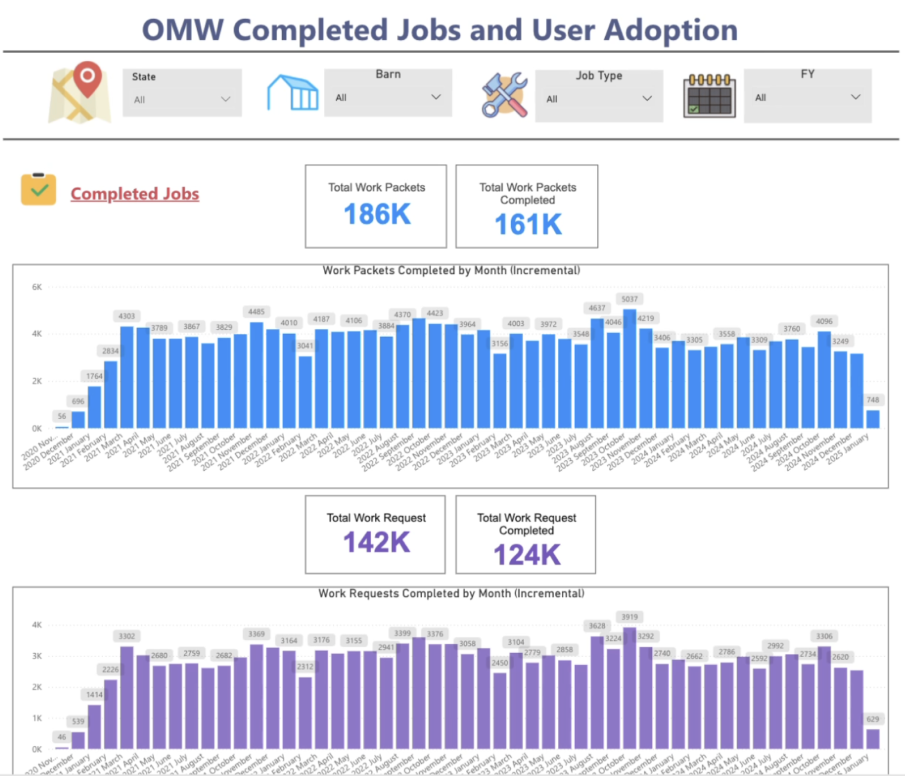
After the rebuild and replatform I led, the share of jobs crews completed rose from 45% to 83%. Claimed jobs land on the timesheet automatically, the meter form and site photos are captured on site, and completed paperwork routes digitally to a supervisor for approval. In usability testing, clearer navigation lifted task success from 68% to 95%, and removing modal interruptions from photo capture cut task time 32%. Platform totals below cover OMW since launch (Nov 2020 – Jan 2025), so they show adoption, not my results alone.

161K
Work packets completed, of 186K
124K
Work requests completed, of 142K
94%
Of completed work packets self-assigned by crews, since launch
National Grid BI dashboard titled OMW Completed Jobs and User Adoption: 186K total work packets with 161K completed, 142K total work requests with 124K completed, and monthly bar charts of completed work from November 2020 to January 2025, mostly between 3,000 and 5,000 a month
OMW BI dashboard, Nov 2020 – Jan 2025. Totals cover the platform since launch, including my Nov 2023 – Jun 2024 work on the rebuild and new features.
09 — WHAT CAME NEXT

A roadmap tied to outcomes, not features

OMW kept growing after my time on it. The team's FY25 plan tied each quarter to a transformation goal instead of a list of releases that could change. Automating close-out of short-cycle work, the core of the rebuild, was the first goal marked complete.

FY25 transformation plan and open opportunities (National Grid's fiscal year runs April to March). Recreated from the OMW strategy overview, Feb 2025.
10 — REFLECTION

What I learned

SMEs can stand in when users are hard to reach. When direct access to crews wasn't possible, subject-matter experts' knowledge became a proxy for user research.

Map past the product. The biggest savings sat in teams who never open OMW, like clerks and work order completion, so the process maps mattered as much as the screens.

Agree on the measurement early. Picking the two timestamps before launch made the impact easy to prove later.

Quick wins build trust. Early, visible improvements earned UX credibility, which made it easier to evangelize better process alongside design craft.