
National Grid

On My Way / Field Force App – HCD Case Study
Role: UX/UI Designer, Human‑Centered Design (HCD)
Org: National Grid
Timeline: ~9 months
Platforms: iOS / Android (cross‑platform)
Date: January 2026
Executive Summary
The On My Way initiative digitized National Grid’s field workflows via the Field Force App and Crew Work Request (CWR). I led end‑to‑end product design—from field research and workflow mapping to prototyping, usability testing, and launch quality—delivering measurable outcomes:
94% faster job close‑out (from 77 days to 1–5 days).
20–35% productivity gains; ~50k additional jobs/year.
10–15% fewer repeat truck rolls; ~$600k annual savings.
~$4.5M in work assignment efficiency via CWR.
7k–13k hours saved from paperwork elimination; $60k–$100k printing saved.
Total annual value: $78M–$80M (efficiency, capacity, risk reduction).
Context & Problem
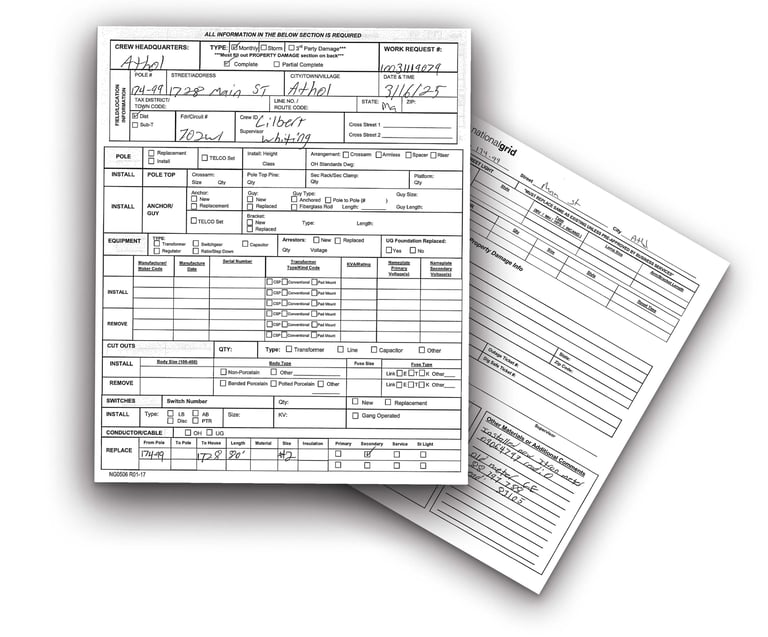
Prior to the app, crews relied on paper packets, radio/phone for dispatch comms, and multi‑handoff approvals, making close‑out stretch to as long as 77 days. Information latency caused repeat truck rolls, documentation was error‑prone, and safety/compliance steps were inconsistently captured—impacting costs, customer satisfaction, and audit readiness.
Objectives & Success Metrics
Replace paper with digital workflows
Enable real‑time, bidirectional crew‑dispatch communication
Deliver CWR self‑assignment based on location/availability
Build safety & compliance into the flow (mandatory, timestamped steps)
Compress cycle time from assignment to close‑out
Success KPIs: 94% faster close‑out; 20–35% productivity; 10–15% fewer repeat rolls; $4.5M work‑assignment efficiency; $630k–$1.17M paperwork time savings; $60M added capacity.
Team & Stakeholders
Core: HCD (UX/UI + Research), Product, Mobile Eng, Field Ops, Dispatch, Safety/Compliance, Data/Analytics.
My role: Translate field insights into product decisions, own UX quality from discovery through delivery, and ensure adoption by partnering on training and in‑app guidance.
Research Approach
Ride‑alongs & field observation (gas & electric crews; urban/suburban).
Contextual inquiry with dispatchers and supervisors.
Artifact analysis (paper packets, forms, compliance checklists).
Journey mapping workshops to align on current & target states.
Rapid moderated usability testing (weekly) in realistic conditions (gloves, glare, low connectivity).
Key Insights
Info latency → rework & repeat truck rolls.
Paperwork & data entry were the biggest non‑value‑added time sinks.
Radio/phone created misalignment and missing status.
Safety steps were inconsistently documented under time pressure.
Crews needed one‑handed, glanceable UI, strong offline support, and mandatory fields for critical data.
Personas & Primary Use Cases
Field Technician (primary): receive work, navigate, perform tasks, document, close.
Dispatcher: assign/prioritize, monitor progress, resolve blockers
Supervisor: review exceptions, audit safety/compliance, approve escalations.
Design Principles
Glanceable First: large tap targets; progressive disclosure; high‑contrast.
One‑Handed & Outdoor‑Ready: thumb zones; minimal typing; voice/photo capture.
Safety‑by‑Design: required steps; just‑in‑time checks; hazard prompts.
Offline‑Resilient: local caching; queued sync; optimistic updates.
Data Completeness: structured inputs; validations; auto timestamps/GPS.
Information Architecture & Flows
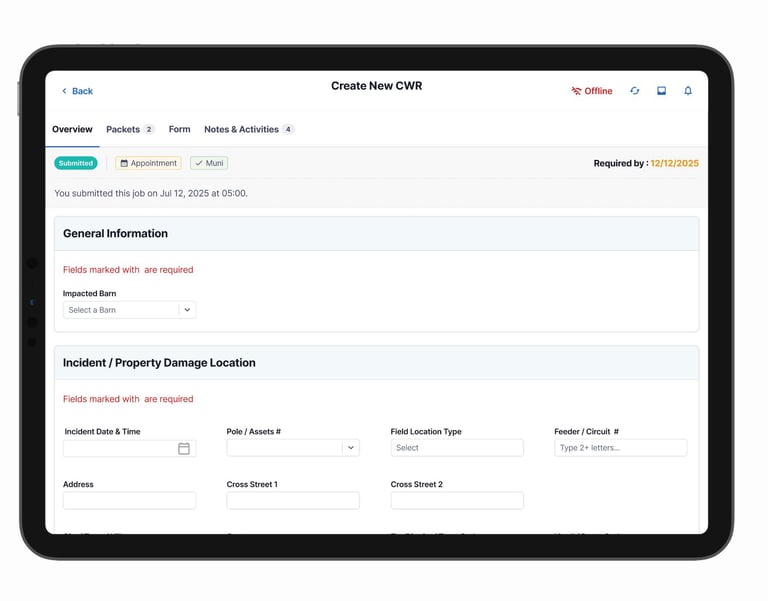
Modules: Home (My Jobs), CWR (Available Jobs), Job Detail, Tasks & Safety, Notes & Media, Close‑Out, Notifications.
Flow highlights:
CWR self‑assignment: crews pull nearby jobs by location/skill.
On My Way: single tap confirms dispatch & customer ETA.
Perform & document: guided tasks + safety checks, photos, barcodes.
Close‑out: structured evidence, validations, autosave, GPS/time stamps.
Sync & notify: resilient offline queue with conflict handling.
Key UX Decisions
Job cards with Service Level Agreement, location, safety flags at a glance.
Micro‑interaction for “On My Way” (updates ETA + notifications)
Structured close‑out with checklist, photo prompts, barcode/asset capture.
Smart defaults and quick actions (reduce typing, avoid modals).
Error‑proofing: confirmations for irreversible steps, autosave for everything.
Accessibility & Inclusion
Designed toward WCAG 2.1 AA: high‑contrast palette, 16–18pt base type, status via color + shape, voice dictation, screen‑reader labels. Field testing included users wearing gloves and corrective lenses.
Prototyping & Testing
Low → high‑fidelity prototypes iterated over 10+ rounds with 40+ participants.
Task success: 68% → 95%; time‑on‑task: –32%.
Notable improvements from testing: simplified nav, bolder status states, fewer modal interruptions, faster photo capture with auto‑tagging.
Measurement & Outcomes
Job Close‑Out: 77 days → 1–5 days (94% faster) → ~$12M annual revenue acceleration.
Repeat Truck Rolls: –10–15% → ~$600k annual savings.
Comm Efficiency: 6,600–10,000 hrs saved ($594k–$900k).
Paperwork: 7,000–13,000 hrs saved ($630k–$1.17M) + $60k–$100k printing.
Work Assignment: 50,000 hrs saved ($4.5M) via CWR self‑assignment.
Productivity: +20–35% jobs/day; ~50k additional jobs/year ≈ $60M capacity.
Safety/Compliance: –20–30% violations; $500k–$1M risk reduction.
Total estimated annual value: $78M–$80M.
Business Impact & ROI
Faster billing cycles, improved customer satisfaction (shorter response/restore times), and stronger audit readiness with complete digital records and time/GPS‑stamped evidence.
Delivery & Change Management
Partnered with field trainers on micro‑learn modules & in‑app tips.
Phased rollout with a champion network.
In‑app analytics for adoption, completion rates, and exception trends.
Risks & Mitigations
Connectivity gaps → offline‑first sync; queued updates.
Device variance → responsive layouts; performance profiling.
Data quality → mandatory fields; barcode/photo evidence; validations.
Change resistance → early crew co‑design and pilot champions.
What I Shipped
CWR self‑assignment (location/skill aware).
On My Way status + ETA notifications.
Job detail with safety banners & task checklists.
Close‑out with structured evidence & auto timestamps/GPS.
Exception handling (access issues, parts shortage, hazard escalation).
Lessons Learned
Designing for the field prioritizes reliability over flourish. Tight, respectful feedback loops with crews build trust and produce the right solution. Small micro‑interactions (e.g., faster photo capture, auto‑tagging) compound into enterprise‑scale time savings.
Next Steps
Predictive scheduling using historical patterns + grid conditions.
Personalized workflows based on certifications & on‑truck equipment.
Safety analytics & anomaly detection.
Deeper asset‑management integration for condition‑based maintenance.
Supervisor Dashboard updates the receiving end to Field Force app
Appendix: Metrics Assumptions Snapshot
Assumes ~200 crews, 20k–60k jobs/year, $90/hr blended crew cost, $300 per truck roll, Fuel Saving $200 per truck roll,$1,400/job average value.